
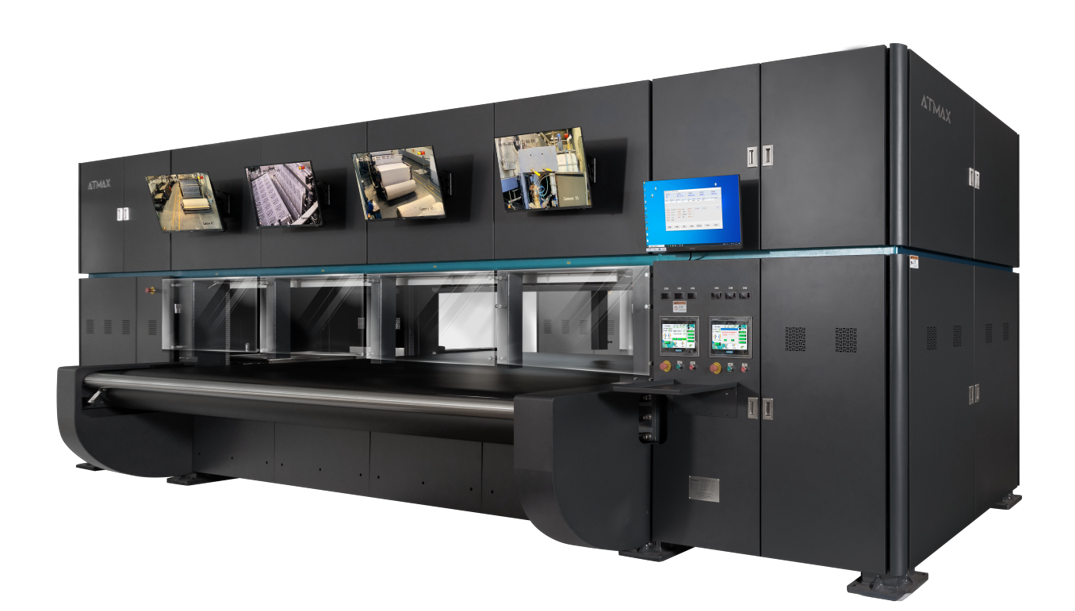
How Digital Carpet Printing Works: From File to Finished Floor
Digital carpet printing can look like magic — a design file goes in one end and a fully printed carpet comes out the other, with no screens in sight. But there’s a clear, logical process behind it. Understanding the steps helps manufacturers see exactly where the time, cost, and quality savings come from. Here’s how a design becomes a finished carpet on a system like the Atmax VEGA series.
Step 1: Design preparation
Everything starts with a digital file. The artwork — whether an original design, a customer’s pattern, or a scanned motif — is prepared in software, where colours are set and the design is sized to the carpet. Because the process is fully digital, there’s no limit on the number of colours or on the size of the pattern repeat. A design with hundreds of colour gradients is no harder to print than a simple two-colour one.
Step 2: Loading the substrate
The carpet or pile fabric is fed into the printer. The VEGA platform handles a range of fibre types — nylon, wool, and dyeable polyester — and is built to run continuously, so material can feed through 24 hours a day without the constant stops that screen changes force.
Step 3: Direct digital printing
This is where digital diverges sharply from tradition. Instead of pressing dye through a series of screens, the printer fires ink directly onto the fabric from a digital print head, exactly following the file. There’s no screen to align, so there’s no registration error between colours. There’s no colour paste to pre-mix, because the system prints colour directly. And because each pass is controlled digitally, detail and sharpness stay consistent from the first metre to the last.
Step 4: Fixing and finishing
After printing, the ink is fixed to bond it permanently to the fibres. On nylon, wool, and dyeable polyester, the VEGA process achieves this without the water-wash stage that conventional dyeing depends on — which is what makes it wash-free and pollution-free. The finished carpet comes off the line with vivid, durable colour and no wastewater stream left behind.
Where the savings come from
Laid out step by step, the advantages become obvious. Eliminating screens removes the cost of making and storing them, plus the labour and downtime of swapping them. Direct digital colour removes paste mixing and registration error. Continuous operation lifts throughput. And the water-free fixing stage cuts both utility costs and environmental impact. Each step that traditional printing adds, digital printing removes.
Built for flexibility
The deeper benefit is flexibility. Because changing a design means changing a file — not rebuilding a set of screens — manufacturers can switch between jobs in minutes. That makes short runs, custom orders, and even one-off 3D high-definition art rugs commercially viable, opening product categories that simply don’t work under a screen-based model.
The takeaway
Digital carpet printing isn’t a single clever trick — it’s a streamlined chain where every stage is faster, cleaner, or more flexible than its traditional equivalent. For manufacturers, understanding that chain is the first step to seeing where it fits in their own production.
Curious how the VEGA series would handle your designs and fabrics? Request a consultation with the Atmax Africa team.